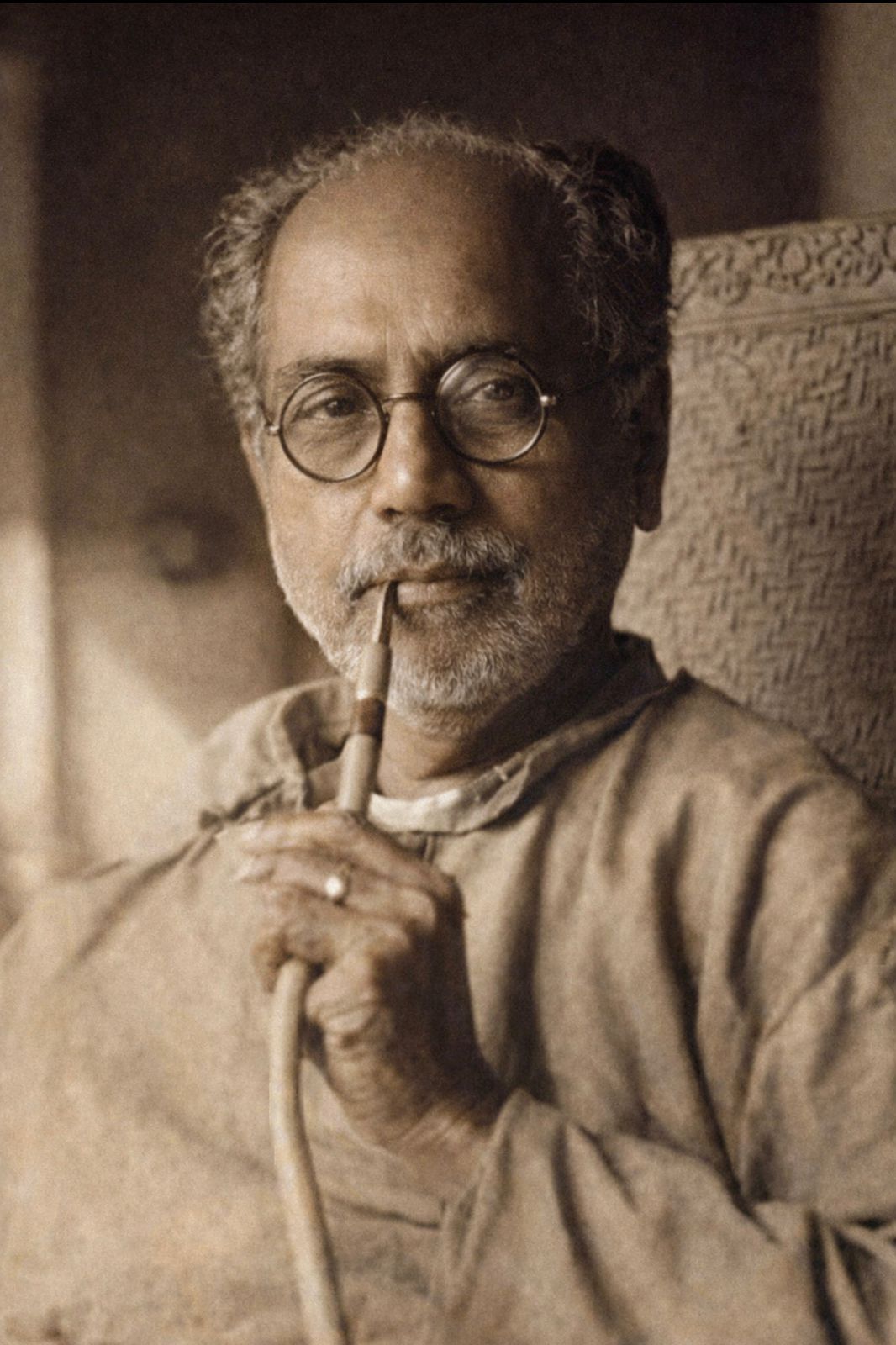
Profile:
Abanindranath Tagore stands as a foundational figure in the history of modern Indian art and the principal architect of the Bengal School of Art, a movement that sought to redefine artistic identity in colonial India. Born in 1871 in Kolkata into the distinguished Tagore family, he emerged at a critical moment when Indian artists were negotiating the dominance of European academic realism.
Educated initially under European academic methods at the Government School of Art, Calcutta, Abanindranath gradually turned away from Western naturalism in search of a more indigenous visual language. Influenced by Mughal and Rajput miniature painting, as well as Japanese wash techniques introduced through interactions with artists such as Okakura Kakuzō and Yokoyama Taikan, he developed a distinctive style characterised by delicate brushwork, muted tonalities, and lyrical atmosphere.
His most iconic work, Bharat Mata (c. 1905), became a powerful symbol of cultural nationalism during the Swadeshi movement, presenting the nation as a serene, ascetic figure imbued with spiritual dignity. Unlike the material realism of European painting, Abanindranath’s art emphasised suggestion, mood, and spiritual resonance, aligning with broader anti-colonial efforts to reclaim Indian cultural identity.
As Vice-Principal of the Government School of Art and later as a central figure at the Indian Society of Oriental Art, Abanindranath played a pivotal role in shaping art education and discourse in early twentieth-century India. His influence extended to a generation of artists including Nandalal Bose, Asit Haldar, and Kshitindranath Majumdar, who carried forward and diversified the ideals of the Bengal School.
Beyond painting, Abanindranath was also an accomplished writer and thinker, contributing significantly to children’s literature and art theory. His works were exhibited internationally, and his ideas resonated within broader Asian artistic exchanges.
Abanindranath Tagore’s legacy lies in his reorientation of Indian art away from colonial paradigms toward a culturally rooted modernism, making him one of the most important figures in the formation of modern Indian visual identity.