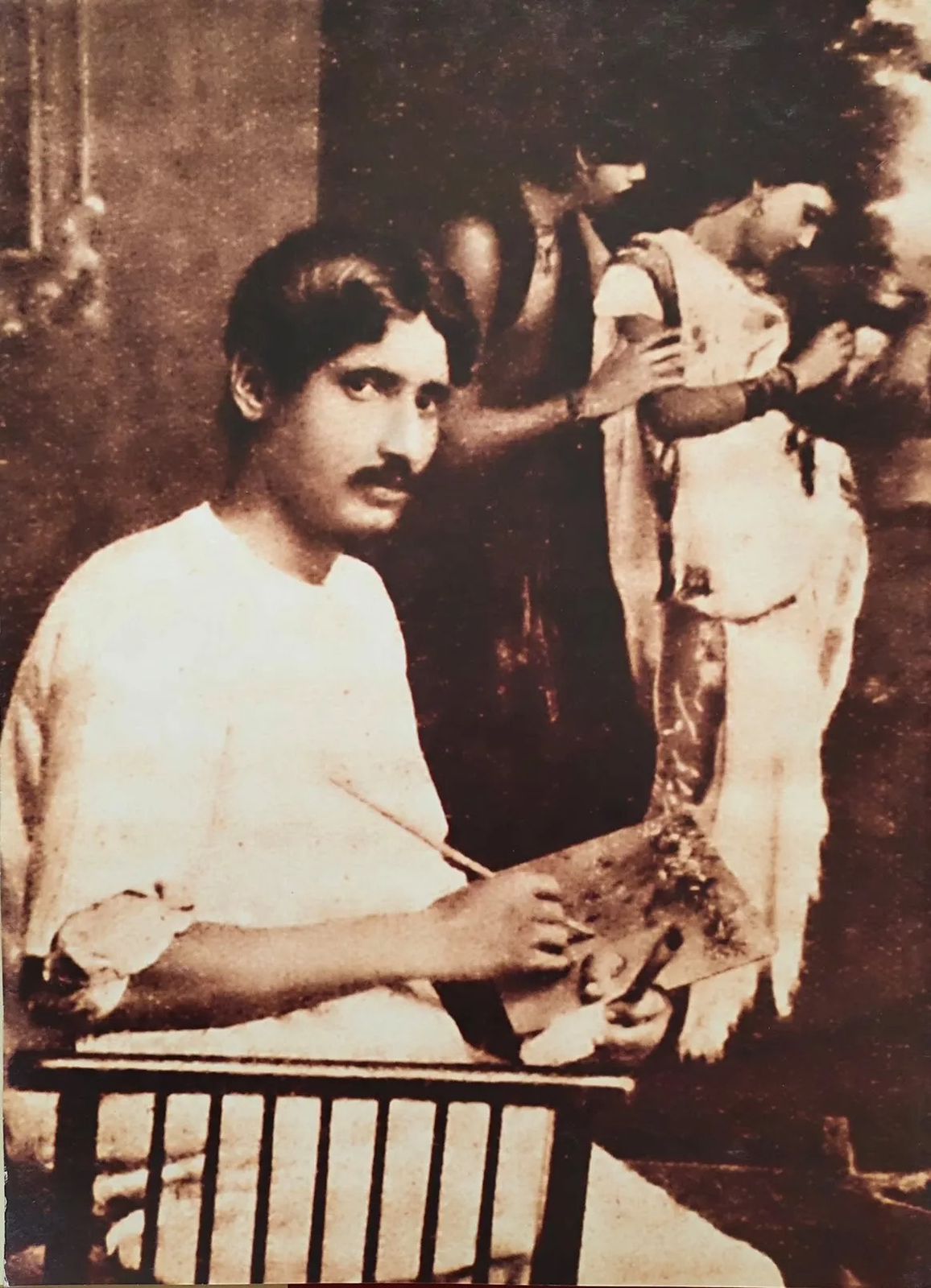
Profile:
Hemendranath Mazumdar occupies a distinctive place within early twentieth-century Indian art as a leading exponent of academic realism in Bengal, whose work offered a compelling alternative to the revivalist ethos of the Bengal School. Born in 1894 in Jessore (now in Bangladesh), Mazumdar received his formal training at the Government School of Art, Calcutta, where he studied under prominent academic artists and developed a strong foundation in European realist techniques.
At a time when many artists were turning toward indigenous revivalism, Mazumdar remained committed to naturalistic representation, mastering the medium of oil painting with remarkable technical finesse. His works are particularly celebrated for their sensuous treatment of the human figure, especially his iconic depictions of women draped in wet sarees, where the play of light on translucent fabric becomes central to the composition.
Mazumdar’s paintings are characterised by meticulous attention to texture, tonal gradation, and anatomical precision. His ability to render the sheen of wet cloth, the softness of skin, and the subtle interplay of light and shadow reflects a deep engagement with European academic traditions, yet his subjects remain rooted in Indian social and cultural contexts. The women in his paintings are not merely studies in form but evoke a quiet introspection, often imbued with emotional and psychological depth.
His work can be situated within the broader framework of Bengal’s academic realist tradition, which coexisted alongside the Bengal School but pursued a different aesthetic trajectory—one aligned with illusionism, materiality, and corporeal presence rather than spiritual suggestion.
Mazumdar exhibited widely during his lifetime and received critical recognition for his technical mastery. His works were shown at major exhibitions including those organised by the Academy of Fine Arts, Calcutta, and he garnered several awards and honours. Today, his paintings are held in important collections and continue to attract scholarly and market attention for their distinctive blend of sensuous realism and painterly sophistication.
Hemendranath Mazumdar’s legacy lies in his unwavering commitment to academic realism, positioning him as one of the most accomplished painters of the human form in modern Indian art. His work remains a vital reference point in understanding alternative modernities within the Indian art historical canon.